The World’s Most Successful Food Challenges

A well-designed food challenge can be very beneficial to a restaurant’s marketing campaign, and as time goes on that challenge may actually evolve into a famous and well-known symbol of that particular restaurant. This is rare, but there are multiple examples of nationally and even globally recognized food challenges that are the first things people think of when they hear the terms “food challenge” and “Man v Food” (the television show). I have been doing food challenges since 2010 and over the years I have talked to thousands of people about different challenges I have done and ones that I haven’t done. There are a few challenges that people always bring up no matter where I am at, and these challenges each have had thousands of attempts because everyone knows about them. They each started as a simple challenge years ago and have steadily grown into the legendary eating challenges that they are today. Here are the world’s most successful food challenges:

The Big Texan’s 72oz Steak Challenge

@ The Big Texan Steak Ranch in Amarillo, Texas (USA)

Jester’s Kidz Breakfast Challenge

@ Jester’s Diner in Great Yarmouth, England (UK)

Big Pie In The Sky’s Carnivore Challenge

@ Big Pie In The Sky in Atlanta, Georgia (USA)

Jack-n-Grill’s Breakfast Burrito Challenge

@ Jack-n-Grill in Denver, Colorado (USA)

Kooky Canuck’s Kookamonga Challenge

@ Kooky Canuck in Memphis, Tennessee (USA)

The Lucky’s Sandwich Challenge

@ Lucky’s Sandwich Company in Chicago, Illinois (USA)

The Eagle’s Deli Challenge Burger

@ Eagles Deli and Restaurant in Boston, Massachusetts (USA)

Crown Candy’s Milkshake Challenge

@ Crown Candy Kitchen in St Louis, Missouri (USA)

The Kitchen Sink Sundae Challenge

@ San Francisco Creamery in San Francisco, California (USA)

Thanks for checking out the world’s most successful food challenges and using FoodChallenges.com!!

To go back and view other Improving A Challenge articles, click here.

The Smartest Restaurants In The World

Food challenges do not lose their luster on their own, but they do not become successful on their own either. It takes a very intelligent owner and marketing department to put together a solid food challenge that really works well for the restaurant. Many restaurants are able to put together great challenges though because there are just so many possibilities to choose from, but it takes an even more intelligent owner and marketing staff to put together and carry out a marketing plan that really takes off and gets that food challenge an enormous amount of attempts and press throughout the local and national news media. Successful food challenges do not just happen by accident, and there are definitely some restaurant owners that are smarter than the rest, and that intelligence shines through the success of the restaurant’s challenge. Here are the smartest restaurants with food challenges around the world along with reasons why they made the list so you can learn from them:

Murphy’s Law – Athlone, Ireland

Murphy’s Law is located in a smaller town in Ireland, and has 2 food challenges. They have a Big Murph Burger Challenge and a Murphy’s Law Breakfast Challenge. Both challenges work very well together and are around the same size and weight. They are also both priced very reasonably which makes them even more attractive and fun. Even in a smaller isolated town, there are people attempting both challenges every single day, and people have traveled from all over Ireland to Athlone just to attempt one of the challenges. How do I know? I know because the restaurant posts the challengers each and every single day via social media. Murphy’s Law definitely put their restaurant and town of Athlone “on the map” through hosting their two challenges.

Stella’s Bar & Grill – Omaha, Nebraska (USA)

As soon as you walk into Stella’s Bar & Grill, you are immediately greeted by a massive Wall Of Fame and Wall Of Shame displaying all of the over 300 people that have attempted their Stellanator Burger Challenge. The challenge is very reasonably priced, and they used a perfect name to drive their marketing campaign. The restaurant staff makes a big deal of the challenge and really creates an atmosphere that makes customers want to take the challenge and get up “on the board” at the entrance. Stella’s has been been featured on every local news media outlets and several national news outlets such as CNN due to The Stellanator. Also, Stella’s created a perfectly sized challenge. A ton of people have gotten within a few small bites, but only an elite few have actually beaten the challenge within the 45 minute time limit. That is exactly what you want to happen!!

Melt Bar & Grilled – Cleveland, Ohio (USA)

Melt Bar & Grilled is a classic example of how creating a very unique challenge that is completely different from all other challenges can really get your restaurant noticed. The Melt Challenge consists of a 4lb grilled cheese sandwich with 13 different types of cheeses, and is served with 1lb of fries and coleslaw. The 5lb challenge only awarded a free shirt, and therefore did not have many attempts or victories. Due to the uniqueness though, the challenge was featured on Man v Food: Cleveland, and now the challenge has had hundreds of attempts at each of the multiple locations throughout Cleveland, all while still only awarding a free shirt and charging full price for the meal. Based on the prizes awarded, the challenge never would have taken off. Due to the uniqueness though, they were featured on a national TV show and now it gets attempted so often that they don’t even need to discount it. Melt is really reaping all of the benefits from having a unique challenge. Everyone traveling to Cleveland already knows about the restaurant before arriving, so it is usually on their list of places to eat.

Smokey’s Joint – Walsall, England

Smokey’s Joint has a Monster Burger Challenge, Monster Dog Challenge, Monster Burrito Challenge, and also a spicy Ghost Chilli Wing Challenge. Smokey’s has been featured in news media outlets all over England, and is located in a small town right outside of Birmingham. Smokey’s has a discount challenge night where each challenge price is discounted in order to encourage people to attempt them and bring friends & family along too. Smokey’s is located right next to Walsall’s train station, so having multiple well-known challenges helps them get traffic from people just visiting Walsall, since the train is the main way that people get there, and Smokey’s is the first place they see when leaving the station. Because of the similar challenge names, the marketing is much easier, and they definitely market all 4 challenges together each week, which gets more publicity.

Pointer’s Pizza – St Louis, Missouri (USA)

Pointer’s Pizza has been hosting The 28″ Pointersaurus Pizza Challenge since 2001, and consists of a 28″ 11lb (5kg) pizza with 2 meat toppings or 4 vegetable toppings. Teams of 2 have 1 hour to finish the $50 pizza. If they win, the pizza is free and the team gets a check for $500. Only 1 team is allowed to attempt the challenge at 3pm 6 days per week. Since 2001, the challenge has been attempted 4-6 times per week, and there has only been about 30 winning teams. That is $15,000 paid out, but try adding up $50 x 4 (times per week) x 52 (weeks per yer) x 14 (years). Pointer’s Pizza has been featured on many national TV shows, and was not selected for Man v Food: St Louis simply because of Crown Candy Kitchen (also in St Louis) having one of the oldest food challenges in the world, which just happens to be one of the only milkshake challenges in the world too. How can you beat that? 95% of people around St Louis have heard of the Pointersaurus, and winning teams have come from all over the entire country. To see a list of winners and where they are all from, please click here.

The Austrian Schnitzelhaus – Sydney, Australia

Food challenges and competitive eating are really starting to grow in popularity throughout Australia, and The Austrian Schnitzelhaus with two locations in Erina and Neutral Bay of New South Wales near Sydney is really taking advantage of the growth. Each location hosts a 1kg chicken schnitzel challenge that comes with chips and a 1 litre beer. The challenge gets many attempts at each location, and multiple YouTube videos can be found of Australian eaters attempting to break the challenge record to earn the free meal. The food challenge trend began very recently in Australia, and The Austrian Schnitzelhaus is really capitalizing on the benefits that come with hosting a proper food challenge. Since it’s not massive, a lot more people attempt it and order it for fun!!

To go back and view other Improving A Challenge articles, click here.

When It Is Best To Not Have A Food Challenge

The right kind and type of food challenge along with fitting details and rules, all carefully selected based on the particular restaurant hosting the challenge, can definitely benefit any and all restaurants. While this is true, some bars and restaurants just weren’t meant to host a food challenge. Some people were born to play sports and some people were born to sing, and many people just weren’t born to do either. This also goes for diners & restaurants wanting to host food challenges, because some restaurants just weren’t meant to host one, and its best that they don’t. Telling every restaurant owner that he or she should host a challenge is just like telling every person singing karaoke that they should be a singer. It’s just not true, and you are setting them up for failure. They may try a challenge at their restaurant, but it will cause more problems than benefits. Here are different situations where it may be best for you to just not host a food challenge at your restaurant:

You or your restaurant staff are not 100% on board – Food challenges are a controversial subject in today’s society and not everyone agrees with them. No matter what you say and how wrong they are, it is really tough to get really ignorant people to change their mind, and you cannot force anybody to do anything legally. If you or numerous people on your restaurant staff do not believe that food challenges are moral and ethical, it’s best that you don’t have one because all efforts involved with it won’t be genuine, and your customers will not buy into wanting to try it. Even if your customers are asking for one, it’s best that you just don’t start one.

A large percentage of your clientele won’t be happy – As you read in Things To Consider Before Starting A Food Challenge, you will have customers that don’t agree with you hosting a challenge, and they may get vocal about it. These people have never touched a drink with all 5 fingers before in their lives because their pinky finger is always up, and you can’t do anything about that. If you start a challenge and have a lot of people complaining about it, you may want to think about just cancelling it. If you know that many of your customers won’t agree with you having one, it’s best to not create one, simply because you need their business. The miserableness of those few customers will ruin the fun for everyone else, but you don’t want to have to deal with that mess.

Your restaurant does not have any type of competitive atmosphere – If your restaurant does not have any type of competitive attitude, and you don’t really cater to the type of people that would even care that you had a food challenge, your challenge obviously will not work. A product may be the best of its kind, but that product won’t work if there is nobody that will buy it. As the restaurant owner, you may think it would be fun to have a food challenge, but if you know that 95% of your customers won’t care no matter what the challenge even is, you definitely should focus on other ways to promote your restaurant. It wasn’t meant to host an eating challenge.

These are really the only 3 reasons that a food challenge may not work for a restaurant. No matter how small or large the restaurant is, the right kind and type of food challenge can still work if people want it to. Even at a small restaurant in a small town that typically caters to the same people, a food challenge can definitely work. That particular restaurant might just have to change the challenge up when it seems like everyone that was wanting to try it already has. As we continue to Feed The Movement, food challenges and competitive eating will continually become more and more “accepted” by people, and the amount of ignorant “haters” will continue to decrease as well. Most importantly, more people will be wanting to try your challenge. You cannot change everyone though, and ignorance combined with freedom of speech is not a good combination. I have seen restaurants with food challenges get featured on the news because a particular columnist with the media outlet did not agree with food challenges. While many people will take your side in the argument, you don’t want that kind of press for your restaurant, so it’s better that you don’t create a situation that can start it. If people will disagree with you having a quantity challenge, try starting a small speed or spicy challenge. Buffalo Wild Wings took this approach and created a small and fun spicy challenge. If hardly anybody will want to try the challenge no matter what it is, then don’t worry about even trying to start one. This article pertains to very few cafes & restaurants, but I wanted to be sure to mention that food challenges weren’t meant for absolutely everyone.

Thanks for reading when it is best to not have a food challenge and using FoodChallenges.com!!

To go back and view other Improving A Challenge articles, click here.

How Stomach Capacity Training Works

Stomach capacity is easily the most important factor in determining your ability to become a successful competitive eater or food challenger. You can have the best techniques and strategies in the world, but if you don’t have the stomach capacity required to finish the challenge meal in front of you, or more than the other people you are competing against, you will not win. Just like taking nutritional supplements and exercising cannot compensate for a poor diet if you are trying to lose weight, great eating technique and strategy cannot compensate for poor stomach capacity if you are trying to win a food challenge. As you learned by reading All Stomachs Were Not Created Equally in the Food Challenges 101 section, no two stomachs are the same, and some people are genetically predisposed to being able to eat more than others. Your stomach is full of tiny muscles that expand (relax) and contract during a process called peristalsis which helps move digesting food through your stomach into other organs to continue the digestion process. Think of your stomach muscles just like you would think of your skeletal muscles that help you move and lift weights. Just like it is possible to strengthen your skeletal muscles through exercise and lifting weights so that you can lift heavier items, it is also possible to train your stomach muscles to expand further so that more food/liquids can be consumed.

By continually training to increase your stomach capacity, you will teach your stomach muscles to relax further and further. There are 3 different training methods you can use to increase your stomach capacity:

1. How To Expand Your Stomach Using Food

2. How To Expand Your Stomach Using Water (Liquids)

3. Expanding Your Stomach Using Food AND Water

Since your stomach muscles are similar to your skeletal muscles, relate them in the following ways:

Stomach muscles can only be expanded to a certain point – You may lift weights religiously for years, and you may continue to progress as time goes on, but your body will only be able to reach a certain level naturally. While your neighbor is bench pressing 400 pounds for multiple repetitions, you may never be able to bench press 300 pounds. As mentioned above, some people are genetically predisposed to being able to lift more than others. This same phenomenon exists with stomach capacity. You may train consistently for years, but you may never be able to eat more than your friend who is naturally able to eat a lot. He or she may have a body type that is more prone to having a higher capacity level. Your genetics and body type play a big role in deciding the maximum potential that your muscles can reach, but all muscle performance can be improved through consistent training. You must adapt your training regimen to fit your body type and capabilities.

If you don’t use it, you will lose it – If you workout consistently and eat correctly, you will build muscular strength and endurance, and you will eventually be able to perform at a higher level than when you first began training. Once you build that strength and endurance, and reach the level that you were aiming for, you must continue exercising your muscles to maintain that strength and endurance. If you quit training and stop working out, your muscle strength and endurance will decrease and eventually go back near the level that you started at originally. If you don’t continue to maintain your stomach capacity, your stomach muscles will contract back to being near the size that your stomach was at before you began training. If you actively compete in eating competitions, you can build a pretty high stomach capacity. If you then take multiple months off and let your body rest, you should definitely not expect to compete at the level you ended at previously when you start competing again. You must train your muscles again to get back to the level you were at when you stopped training. Rest is important and vital to recovery & improvement, but there is a such thing as too much rest.

It is possible to overtrain – In the fitness world, overtraining is a physical, behavioral, and emotional condition that occurs when the volume and intensity of an individual’s exercise exceeds their recovery capacity. They cease making progress, and can even begin to lose strength and fitness. Overtraining is a common problem in weight training, but it can also be experienced by runners & other athletes. Overtraining can be experienced by competitive eaters trying to expand their stomach capacity too. When lifting weights, you should not exercise the same muscles every single day. You need to let your muscles rest and recover so that they are able to grow and get stronger. Your stomach muscles operate the same way, and you should not train to increase your stomach capacity every single day, and especially multiple times per day. If you do train too often for a long period of time, your stomach muscles will start to experience overtraining symptoms. You will notice that your stomach capacity is starting to decrease and you will get fuller faster. If you are training with food, you will more than likely experience excess weight gain too. To recover from overtraining your muscles, you must let them rest for a long period of time until they have recovered back to full strength. There is no other way.

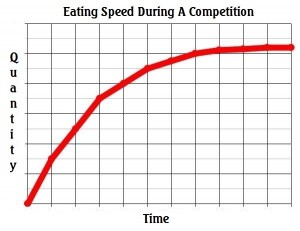
Stomach Capacity TrainingThe higher your stomach capacity is, the more foods and liquids that you will be able to safely fit into your body during a food challenge or eating contest. Stomach capacity plays an even larger role in longer eating contests than it does in challenges. As shown in the graph to the left, eating speed during a food competition has a geometric pattern, meaning that you start off very fast in the beginning and your speed begins to decrease as time goes on until you are basically crawling at a snail’s pace. The point where an eater feels like he or she is completely full and is no longer able to continue eating is known as “the wall.” You can immediately tell when an eater has hit “the wall” by his or her face and body language. When you hit “the wall,” you begin chewing without wanting to swallow. The higher your stomach capacity is, the longer it takes for you to hit the dreaded “wall.” That is why stomach capacity plays such a huge role in eating contests, because eaters with a larger stomach capacity are able to eat faster and more food for a longer period of time. Longer eating contests last between 6 and 10 minutes, while longer food challenges last 45 minutes to 1 hour, and therefore an eater has more time to work with. The eater can start off very fast the first fifteen to twenty minutes, and then he or she has additional time to coast to victory.

Just like when training with weights, you must build your capacity and endurance slowly. As the saying goes, Rome was not built in a day. If you try to lift too much weight, it can fall right on top of you and you can get seriously hurt. You can also tear your muscles and fracture your bones and joints. If this happens, you must take a long time off so that you can recover. You therefore are unable to compete in any activities until you are healed, and you will lose all of the strength and endurance that you worked so hard to gain. If you are not careful and overtrain your stomach muscles, you can get seriously hurt. As mentioned in The Dangers Of Competitive Eating, it is highly unlikely that your stomach muscles will tear, but you will more than likely end up throwing up, and throwing up often for a long period of time can have seriously damaging effects on your body and digestive organs. You will also more than likely gain a significant amount of excess weight. You will then be forced to take a long period of time off so that you can let your body rest and lose the excess body fat, and therefore you will not be able to compete in many eating competitions, if any at all. True stomach expansion takes time and a lot of consistent training. There are no shortcuts. For more information about that, click here.

Thanks for reading about how stomach capacity training works and using FoodChallenges.com!!

To go back and view other Stomach Capacity Training articles, click here.

True Stomach Expansion Takes Time

The single largest mistake that amateur competitive eaters make when first starting out is attempting too large of a food challenge too soon in their career. No matter what recreational activity or sport you compete in, losing is not fun, and it can be very discouraging. There are some people that could have potentially been great competitive eaters, but they made the mistake of attempting too large of a challenge too soon, failed the challenge, and therefore got discouraged and quit trying altogether. To be successful, you must start slow and build up your eating capacity and endurance. It is very rare that an amateur first starting out is ever able to beat a true professional eater in an eating contest. Like mentioned in other articles though, some people are just genetically predisposed to being able to eat more than others. Most professionals have spent years competing, training, and building their stomach capacity into what it is today. Many professional eaters after a few years of competing can eat twice as much as they could when they first began in the same amount of time, and they can eat the amount that they originally started at in just a fraction of their original time. To see how many hot dogs and buns Joey Chestnut ate during his very first Nathan’s qualifier back in 2005, compared to the 69 hot dogs that he can eat now in the same amount of time, read Elite Eaters Are Made Not Born. There is also some great information related to this article that I just don’t want to repeat, so please read that before you continue.

When I first began my eating career in 2010, I had to train before each and every event so that I could be ready to defeat each of the food challenges that I attempted. If I did not train at all, I definitely would not have been successful. After a few victories, I started to get cocky and thought I was better than I really was. My most memorable example of this was The Tenderloin Challenge at BrewTop Pub & Patio in Kansas City, Missouri. I thought that I would be able to defeat it easily, even without preparing for it, and I was completely wrong.


It ended up being bigger than I expected, and as you saw if you watched the video, I really struggled to finish it at the end. I had to sit down for about 10 minutes afterwards to make sure I kept it all down. You typically don’t learn by winning, but that challenge really put me in my place and it was a long time before I let that happen to me again. With that being said though, I can eat much more now than I could back when I first started. For example, my 4th food challenge ever back in 2010 was The Stellanator Burger Challenge at Stella’s Bar & Grill in Omaha, Nebraska. I struggled to finish the 4.5lb challenge successfully in 25 minutes, and then had a pretty rough time attempting to go out and party afterwards. I went back 40 food challenges later and beat the challenge in 7 minutes and 26 seconds, and then went out and partied like I had not even eaten dinner. Your body will adapt and your stomach capacity will increase, but it won’t happen in just 1 month, and for some people depending on their genetics and body type, it may take over 1 year to get to the level they want to be at. The human body does not respond well to rapid changes, and sometimes the exact opposite reaction from what you were wanting will occur if you try to change your body faster than it can physically adapt to those changes. If you gradually increase your capabilities and don’t try to bite off more than you can chew, you will be able to consistently take steps forward rather than taking steps back. You will safely have much more fun too!!

While watching the video above, I’m sure that you noticed how terrible the video quality and production was. In the beginning, I taught myself how to edit videos and filmed them all myself too. Things are a little better today, and I am sure you noticed that too if you have seen any of my recent videos. Make sure you wake up every single day better and smarter than you were the day before, and you will reach your goals. It took a long time for my stomach capacity to truly increase, just like it took a long time for my videos to get better. If you are willing to put forth the effort required, then your stomach capacity will increase too. Just make sure to train safely using the tips throughout this section, and build up your stomach capacity gradually so that you don’t get really discouraged, hurt, or suffer from overtraining. Also, be sure to build slowly so that you don’t gain any excess body fat. In regards to building your stomach capacity & endurance, slow and steady definitely wins the race.

Thanks for reading about how true stomach expansion takes time and using FoodChallenges.com!!

To go back and view other Stomach Capacity Training articles, click here.

How To Expand Your Stomach Using Food

In an attempt to become a better American football player, I gained over 100 pounds of body weight during high school between my junior and senior football seasons. It took less than 1 full year, and I did not gain all of that weight by taking pills and weight-gainer supplement shakes. While I was a “master sandwich artist” working at Subway for a few months, I was eating 3 double-meat foot-long sandwiches within a 5 hour period. After being released from Subway, I became an executive chef at Burger King, and my typical meal was 8 tacos, 2 double chicken whoppers, a bowl of chili, a chicken or fish sandwich, and then I usually had one or two other items that I created myself which filled up the rest of the tray. Then I had a Diet Coke (just kidding)!! After being released from Burger King, I took a position as the “senior dish washer” at an Italian restaurant, and my meals were large there too. I’m sure you see my point by now. You may gain weight drinking caloric milkshakes, but you won’t gain real weight by taking pills, and you won’t lose weight simply by taking pills either. With that being said, the point of training to increase your stomach capacity is so that you are able to eat more food. If you want to be able to eat more food, you need to train by eating more food, so here is an example schedule to show you HOW:

A One Week Plan For Expanding Your Stomach Using Food

1. Set the date and time – The first thing you must do is to decide the day and time that you will be doing the challenge or contest. If it is a contest, the date and time has more than likely already been decided by the contest host, and you will have to adapt your schedule to fit their event schedule, just like everyone else competing. If it is a food challenge, you are able to decide when you want to take the challenge. Most food challenges are able to be attempted during all normal business hours, as long as you call ahead to notify the restaurant beforehand, letting them know when you plan on coming so that they can have everything ready. Some challenges are only available at certain times of the day or certain days of the week though, so that is why you should always call the restaurant beforehand to set the date and time. You don’t want to spend a week preparing and then get to the restaurant just to find out you can’t take the challenge. That has happened to me before and its very disheartening. Once the date and time is set, you can establish your stomach training plan.

2. The first 2-3 days – During the first 2 or 3 days of the week leading up to your competition, eat one considerably larger meal, and keep the rest of your day similar to your normal routine. You don’t need to completely max out, but definitely make it a lot larger in size than a normal meal. I recommend having a light breakfast, and then having this large meal for lunch. Having the meal earlier in the day allows more time for your body to digest the food, and it is not recommended to eat a large meal just a few hours before bedtime. Your body will be working harder to digest the increased amount of food, and this may effect your sleep pattern if you have this meal too late at night. If your schedule does not allow you to have this meal at lunch, having it for dinner won’t really be an issue. If you lift weights and exercise, you may want to schedule this meal as a high protein recovery meal after your workout. Since you are not maxing out, this meal should not affect your performance at work or school afterwards. Just try to keep the meal around the same time period during these two or three days so that your body can better adapt to the increased amount of food being consumed.

3. Days 4 and 5 – During days 4 and 5 of your training week, you want to reduce your number of meals down to just 2 large meals that are the size of your 1 large meal during the first 2 or 3 days, and maybe even slightly larger. It is recommended to space these 2 meals out so that you are hungry and ready to eat the second meal of the day. Most people choose mid-morning and late-afternoon to avoid having the meal too late at night. Due to the 2-3 large meals leading up to these 2 days, you may notice that you feel more normal after each meal than you did the first few days. This is why you take the time to allow your body to adapt gradually rather than doing all of your training in 1 day. After these intense days, you are ready to push yourself to the limit on day six.

4. Day 6 is max out day – Comparing this day to weight-training terminology, this is the day that you want to max out your capacity so that you are ready to take on your food challenge or eating contest the next day. Since you know the approximate time of your event, you want to schedule your max out meal about 18-22 hours beforehand. This allows the food that you consume to “leave” your body so that your body is basically empty and ready to be filled with all the food required to win your competition. Most competitive eaters choose to eat mostly vegetables and fruits during this meal which are lower calorie foods that are higher in fiber and contain a lot of water. You want to avoid eating a lot of meats and other solid foods that take longer for your body to digest. Some people choose to go to all-you-can-eat salad bar buffets if available, and others buy the required foods and eat the meal at home. Eat as much as you physically can, even to the point of discomfort, but make sure you don’t go overboard. If you try to eat too much, you may end up throwing up and that will definitely affect your stomach’s performance during your event the next day. When you get to that point where your mouth is filled and you are chewing without wanting to swallow, called “chipmunking” in eater-terminology, it is about time to stop. Don’t quit too early though because this meal really affects your performance during your event the next day, and we both know you don’t want to lose. To achieve something you have never achieved before, you have to do things that you have never done before. Remember that 50% effort achieves only 50% results.

This Stomach Capacity Training section is loaded with other tips related to training with food (and liquids too) so that you are prepared for your eating competition, so make sure to check out all of the other articles. They answer every question that you may have, and are not only for people seeking to do better in eating events. You may also use them to prepare for special events where you are wanting to eat more, such as Thanksgiving in the USA, or if you know you are going to an all-you-can-eat buffet and you want to impress your friends and get your money’s worth. As a beginner, you definitely want to start slow and let your body adapt gradually to the changes that you are wanting it to make. By doing this, you will be able to make sure you are training safely and very effectively. There are many Lower Calorie Stomach Training Foods, but please realize that you will more than likely be consuming an increased amount of calories while training with food. Therefore you need to adjust your meals so that you consume less calories during the other times of the day, and know that you may have to decrease your daily calorie intake for a few days after the competition (if it is really high in calories).

For more information to help you plan your max out meal, make sure to read The 24 Hours Before Your Eating Competition in the Before The Challenge section. That has a lot of helpful information you can use to prepare. Also make sure to read How To Expand Your Stomach Using Water and Expanding Your Stomach Using Food AND Water so that you can learn the importance of water and other liquids during your training regimen.

Thanks for reading how to expand your stomach using food and using FoodChallenges.com!!

To go back and view other Stomach Capacity Training articles, click here.
How To Expand Your Stomach Using Water

Even if you are training with low calorie fruits and vegetables such as cabbage or watermelon, there is an extremely high chance that you will be consuming a higher than normal amount of calories than your body is typically used to processing. Also, since food is not digested very quickly, you may experience discomfort for a longer period of time after eating a lot, which is a drawback for obvious reasons. Consistently consuming more calories than you burn off will lead to excess weight gain, and I am not referring to muscle weight in your arms and legs. To avoid the extra calories and increased weight gain, some eaters train to increase their stomach capacity by using water and other calorie-free liquids. While this method can be effective, it can be a lot more dangerous too, so please read The Extreme Dangers Of Water Training if you have not already. With that being said, there are ways to slowly and safely increase your stomach capacity using water, and you must do it gradually to maintain that level of safety. Training with food is much safer and definitely the better option between the two, but to simply say don’t train with water while some of the top professional eaters are training with water would be hypocritical. Follow this liquid training plan to prepare for your eating competition:

A One Week Plan For Expanding Your Stomach Using Water

1. Set the date and time – If you have not already, make sure you have read How To Expand Your Stomach Using Food, so that you can compare the two training methods. While you are using 2 completely different substances to train, you need to follow a similar structured training schedule so that your body can adapt to the changes gradually, allowing you to achieve the best results. Just like when training with food, you need to establish the date and time of your challenge or contest so that you can adjust your training regimen accordingly.

2. Analyze how much water you currently drink – This isn’t an official step really, but before beginning your training week you need to consider your current level of water intake along with your body type. If you rarely drink water, and feel that you don’t even get the recommended daily amount that your body should be getting, please consider yourself a beginner. There really is no set amount of of water to set as a standard because like calorie intake, the amount of water that your body needs is based on your body type, activity level, and other factors. A 5’2″ twenty year old female most likely requires less water than a 25 year old professional athlete who is a 6’5″ and 280lb (127kg) male. If you are not used to drinking water, then your body is not used to consuming a lot of water either, so you need to consider that when selecting how much water you want to drink. You need to increase the amount you train with at a slower pace than somebody who is used to drinking 2 gallons per day on a regular basis. Thinking about this will help you maintain safety and avoid getting hurt.

3. Days 1 and 2 – For the first two days, you basically want to prepare yourself for the upcoming rest of the week by increasing your daily water intake considerably. I am a 6’5″ male weighing 250lbs (114kg), so I try to drink 2-3 gallons of water steadily throughout the days before I am going to involve light water training. Just because that is what I do though, that does not mean you need to have the same goal. Just make it a point of emphasis to drink a lot of water throughout the day and early evening, drinking no more than 1 quart (32 ounces) at a time.

4. Days 3 and 4 – Now you are ready to start drinking more at one time than you did the first two days. Chug 1 quart (32 ounces) of water at multiple times throughout the day. Drinking one quart of water quickly is no where near any kind of dangerous level, so there is no need to mix the water with a flavor and/or electrolyte additive. If you are working or at school, bring along a 32 ounce (1-liter) water bottle to make sure you are getting your water training in during the day, and not just in the evening when you get home. Because water goes right through your body a lot faster than food, and you are not yet dealing with extreme amounts of water at one time, you can chug multiple times per day to help teach your stomach muscles to relax further. Spread the water training sessions out every few hours. Just don’t go overboard, and allow your muscles and organs to rest.

5. Days 5 and 6 – If you were able to chug the quarts of water easily on days 3 and 4, aim for a 1/2 gallon (2 quarts or 2 liters) on day 5. You may have already tried to drink 2 quarts on day 4 if all of the quarts of liquid on day 3 went down easily. Since your body has had some time to adjust to the increased consumption of water, you are able to experiment a little bit more now. Just make sure you don’t increase by more than 1 quart at a time. Do not step up from 1 quart to 3 quarts, especially if you are not adding an electrolyte additive or drinking a liquid with electrolytes already included. Use your results on days 4 and 5 to decide how much to aim for on day 6. If at the end of the day on day 5 you were able to drink both quarts without any discomfort, increase to 3 quarts on day 6. The amount you attempt on day 6 along with how your body reacted will decide how you train on day 7, just a few hours before your eating competition. Take day 6 seriously, but be careful and maintain safety.

6. Day 7 is game day – This article does not really cover day seven which is game day!! For more information on day seven, please read The 24 Hours Before Your Eating Competition in the Before The Challenge section.

Even if you are only wanting to focus on training with food to increase your stomach capacity, you should still be drinking plenty of water throughout the day. Water is the single most important nutrient that you can give your body, and it is also very important to your body’s digestive system. Water is known as the “universal solvent” and plays a vital role in helping to digest and metabolize your food. Since you are putting additional stress on your digestive system due to the increased amount of food you are giving it so that your stomach capacity expands, the water will help take away some of that additional stress. Water is also vital for losing the excess weight you may be gaining due to the increased amount of calories. Water is definitely an eater’s best friend, so do not underestimate its importance. Another reason that eaters choose to train with water is that it is very affordable, and much cheaper than food. 99% of the time it is basically free and very budget friendly.

The training plan established above is meant for beginners looking to find out how competitive eaters use liquids to increase their stomach capacity. At no point in this article do I mention attempting to drink more than 3 quarts (3/4 gallon) in one sitting. As you will learn by reading The Extreme Dangers Of Water Training if you have not already, if you drink too much water at one time and your body cannot handle the amount added, this may deplete your electrolytes in your body which will cause you to basically drown yourself. In a worst case scenario, this can result in death. You may also pass out, and that may result in you falling and hitting your head on something which can cause additional damage on top of the damage caused by drinking too much water. If you are interested in attempting to drink more than 3 quarts of water, which is not recommended, please use a low calorie sports drink such as Gatorade or Powerade which contain electrolytes that make a big difference.

You may have heard a story or two about some of the top elite professional eaters being able to drink over 2 gallons of liquid in one sitting. While that is true, know that it took them multiple years of training to reach that capacity level. If you have been training for 2 months, don’t attempt to train like people that have been training for 12 years. You simply are not at that level, and there is absolutely no shame in admitting that. Also know that you don’t have to drink the liquid all within one minute to experience the benefits. While water gets processed much quicker than food, it does not leave your stomach within minutes. It is perfectly okay to chug a few gulps, and then take a quick break to burp up any excess gas or air created in your stomach, and then continue chugging. You may even take a few minutes if necessary. By taking a few minutes to chug the 3 quarts of liquid, you allow your body to adjust, and you also allow it to let you know if you need to quit so you don’t get dizzy.

If you try to force your body to chug too much, your body may throw the water up and this can harm your progress. You DO NOT want to allow your body to get used to throwing up, so don’t get carried away no matter what. Competitive eating is meant for fun, and it is not worth hurting yourself. Also, know that there are 2 additional drawbacks to training with water. The first thing to realize is that drinking an excess amount of water puts additional stress on your kidneys and a few other internal organs, so don’t think that it is okay to do it all the time just for fun. Too much of anything is not necessarily a good thing. The second thing to remember is that what goes in must go out. Because you are consuming a lot more water and liquids, you will be going to the bathroom more often, so don’t be surprised that you are going to the bathroom a lot more. Also, you may want to avoid chugging water within 3-4 hours of going to sleep. You may find yourself waking up multiple times at night to go to the bathroom. While getting up once or twice is okay and even normal for some people, you don’t want to interrupt your regular sleep pattern because you are always up peeing throughout the entire night.

You have now learned about how to train with food (if you read that article), and also how to train with liquids. While both methods can be very effective, I have found that the safest and most effective way to increase your stomach capacity is to combine both methods. To find out how to do that, read Expanding Your Stomach Using Food AND Water. This is the method that I use which I have been perfecting for the past few years now.

Thanks for reading how to expand your stomach using water and using FoodChallenges.com!!

To go back and view other Stomach Capacity Training articles, click here.

Expanding Your Stomach Using Food AND Water

There’s always at least two totally different sides to every story, and typically the best solution is for both sides to compromise and meet in the middle. This philosophy applies to training to increase your stomach capacity too. Before reading this article, make sure that you have read and understand both How To Expand Your Stomach Using Food and How To Expand Your Stomach Using Water. Each article explains how to train to increase your stomach capacity using each particular method. While both methods can be effective in their own way, and each side has different pros and cons, the safest and most effective way to increase your stomach capacity is to combine both methods and train using both food AND water. So that you can better understand why combining both methods is most effective, and to help you decide how you will train, here are the pros and cons of each:

As mentioned in How To Expand Your Stomach Using Food, the best way to train your body to be able to eat more food is by training with food. While strictly using liquids can help increase your capacity, it won’t help your body adapt to all of the other body processes that are required to hold, digest, and process all of that additional food, in addition to the stomach being able to expand further. By training with food, your system can begin to adapt to the changes you are trying to make, and you will notice that you will begin to not feel the fullness effects as quickly as time goes on. The major downside to training with food though is that you typically take in extra calories, and calories that your body does not use end up being stored as fat. If you continually take in excess calories, you will gain weight which can be damaging to your health and figure, and also your performance.

As mentioned in How To Expand Your Stomach Using Water, the reason that many competitive eaters train with water and other liquids is that water is typically free financially, calorie-free, and it digests and gets processed through your body much faster which means that you won’t have a very long feeling of discomfort. The major downside to water training though is that it can be dangerous, and you can drown yourself if you are not careful. Also, as mentioned above, your stomach may get used to expanding, but your body will not get used to processing the increased amount of food if you only use water, and it adds excess stress on your kidneys.

To basically sum up how to effectively combine both methods, simply follow the one week plan that is referenced in How To Expand Your Stomach Using Food, but then finish each large training meal by drinking a significant amount of water that increases the stretch of your stomach muscles. For example, eat the one large meal on days 1, 2, and 3, but then try to drink an additional 1 or 2 quarts (liters) of water afterwards. The larger meal will help your body begin to adapt to the increased amount of food, and the extra water will help increase the expansion of your stomach so that you can get an increased stomach stretch while avoiding additional calories and a longer period of discomfort. Plus, the water will help digest and metabolize the food you just ate. On days 1-3 during the one big meal referenced, do not go overboard on the water stretch, but do drink enough to feel the additional stretch. You don’t have to worry about drinking too much water because your body is full of food and therefore you are not at risk of drowning yourself. You do not want to go overboard though, because if you try to drink too much water on top of the food, your body may throw up both the water and the food, which will diminish some of your training efforts. Start by drinking a quart, if you even have that much room. You may even want to start off with a pint (16oz) and just keep drinking pint glasses of water until you have reached capacity. It is ok to drink 1 pint, take a break to burp up air, and then continue drinking until you are finished.

Eat your two meals each day on days 4 and 5 just like you would if you were training with food only, and don’t decrease the size of your meals just because you know that you are drinking water right afterwards. Days 1-3 were for preparing you to get more serious on days 4 and 5, so feel free to push your body a little harder on days 4 and 5 with the water stretch after your meals. As mentioned previously, don’t push too hard though. Your body will do the exact opposite of what you are wanting to accomplish if you push it too hard. This will help prepare you to max out on day 6. For more information about the max out meal on day 6, along with what to do right afterwards up until the time of your competition on day 7, please make sure you have read The 24 Hours Before Your Eating Competition in the Before The Challenge section, which also contains helpful guidance and tips.

The stomach capacity training tips are meant to serve as guidelines to help you establish your own training regimen for your own competitions based on your lifestyle, schedule, and personal capabilities. There is absolutely no way to establish a set schedule for everyone to follow with a set amount of food or liquid to consume because every single person is different, and therefore what works for one person may not work for other people. Establishing a preferred training regimen takes a lot of trial and error, and you will not get everything right on the first try no matter how much research and planning that you do. That is why you need to start slow and build your stomach capacity gradually. Train smarter and not just harder. Using all of the many tips throughout this Stomach Capacity Training section and the Before The Challenge section will definitely help you prepare your plan of attack so that you can dominate your food challenges and eating competitions, and continue to get better by learning from each & every experience. Learn. Train. Conquer. #feedthemovement

Thanks for reading expanding your stomach using food and water and using FoodChallenges.com!!

To go back and view other Stomach Capacity Training articles, click here.

The Extreme Dangers Of Water Training

The most dangerous activity linked to competitive eating and food challenges is definitely when people attempt to train to increase their stomach capacity by using nothing but water. This training method is mentioned as one of The Dangers Of Competitive Eating, and it cannot be stressed enough that you need to be very careful using water alone to increase your stomach capacity. If you are really wanting to involve water training into your regimen, please read How To Expand Your Stomach Using Water which contains a beginner’s guide to water training that teaches you how to train safely and gradually for your eating competitions. The safest and most effective way to train with water is to involve food in your training too so that your body is not depleted of nutrients and electrolytes. Please read Expanding Your Stomach Using Food AND Water to learn how to combine both methods of training so that you can increase your stomach capacity safely and very effectively while also consuming less calories and experiencing shorter periods of discomfort during and after your training sessions.

As mentioned in How To Expand Your Stomach Using Water, there are a few professional eaters that are able to drink over 2 gallons of liquid in one sitting. These professionals have trained for years to be able to do that, and they built up their capacity gradually, just like you need to. Also, they do not use just water. They use low calorie sports drinks such as Gatorade or Powerade along with water to maintain their electrolytes. The actual amount depends on your size and body type, but if you try to drink over 1 gallon of regular water really quickly without any prior experience or food in your belly, serious problems are likely to occur. You may pass out and even die. Winning a food challenge or eating contest is not worth risking your life. To learn a pretty good scientific explanation of how too much water can hurt and even kill you, please watch the informative video below.

As you saw during that video, drinking too much H2O while water training is not anything that you want to mess with. In addition to possibly killing you if you have too much too quickly, drinking an excessive amount of water puts a large amount of stress on your kidneys. Your kidneys absorb excess water out of your blood stream, and therefore drinking excessive amounts of water for a long period of time can damage your kidneys, just like drinking alcohol consistently for a long period of time can damage your liver, and you don’t want to do that. Therefore, limit your frequency of training with just water, and increase your frequency of training with both food AND water. Then you have the best of both worlds, and you get to experience the benefits of both while reducing the negative downsides that occur if you have too much of either one. The main goal of food challenges and competitive eating is for everyone involved to have fun, and we don’t want anybody getting hurt. If you attempt to train with just water, and you end up getting hurt or killed, you will not be seen as “dedicated.” You will be seen as an idiot that did not know when to say when. When doing any type of serious stomach capacity training, please do not attempt to do anything that you know your body might not be able to handle.

To go back and view other Stomach Capacity Training articles, click here.

Stomach Training Tips For Hardgainers

Most hardgainers already know that they are, but for those who need a definition, the term hardgainer in the bodybuilding community refers to a person who has a difficult time adding muscle mass and additional body weight through regular diet and weightlifting. They can be both short or tall, and anything in between, but hardgainers are typically skinny and have a lower amount of muscle mass due to an extremely fast & active metabolism. These are the people that can “eat anything they want without gaining weight” that men and women like me who are prone to gaining weight more easily are jealous of. The funny thing is that they are jealous of us because we can gain weight more easily. The competitive eating world is starting to see more and more hardgainers and bodybuilders attempting food challenges because they then have a reason to eat more calories (to win) which can help add the weight they have been trying to add. All people willing to help #feedthemovement are more than welcome to join the community and the more people involved the better.

As mentioned in How To Expand Your Stomach Using Food, I know a little bit about what it takes to gain weight. Between my junior and senior year high school football seasons, I gained over 100 pounds (45kg). While I did not need every single pound that I gained, I definitely did not gain the weight by eating only salads with vegetables and extra lean chicken breasts covered in low calorie salad dressing. As a hardgainer, if you want to gain serious muscle mass and weight, you need to lift heavier weights while getting plenty of rest so that your muscles have time to repair, recover, and grow. Most importantly, you need to eat and you need to eat BIG. You have very little control over how many calories your body burns throughout the day, other than while you are working out and exercising. You cannot just tell your body how many calories to burn. Many different factors are involved.

You may not control how many calories your body burns daily, but you do have full control over how many calories your body consumes. If you do not eat more calories than your body burns each day, you will lose weight rather than gain weight like you are wanting to do. It is amazing how many people think they eat a lot and don’t understand why they are not able to gain weight, but really they don’t eat any more than the average person does. I have definitely learned that “I eat whatever I want” and “I am a big eater” both mean different things to different people. If you are lifting weights, getting plenty of rest and sleep, and not gaining weight or any noticeable muscle mass, you are not eating enough food and there is no doubts about it. You don’t need to add a weight-gainer shake to your nutrition plan. You need to eat more food and you need to eat more food more often. To eat more calories on a consistent basis, you need to train your stomach to be able to fit more food in it at one time so that you can do this multiple times per day. You should definitely train like you are getting ready for an eating competition by using food, and to make things even more interesting you should attempt a challenge after intense resistance training. Since gaining weight is one of your goals, you get to have the most fun!!

Follow the one week training plan featured in the How To Expand Your Stomach Using Food article. During your large meals, make sure to choose foods that are high in protein, complex carbs, and even fats too. You aren’t going to gain the weight you are wanting by eating foods that you would eat while trying to lose weight. Feel free to order a large meat-lovers pizza or make a really big portion of pasta. Check out the Stomach Capacity Training On A Budget article which references different all-you-can-eat buffets that you can go to so that you save money. Then you can pick what foods you want to eat, and you can eat as much as you want of them. Just don’t focus on the dessert items the whole time. While they are additional calories that will help you consume more calories than you burn, you won’t gain a ton of muscle by eating a ton of ice cream. Make sure to get a lot of protein and complex carbs. Along with getting the excess calories, you are also wanting to increase your capacity, so feel free to drink a few pints of water after you have filled up with food. Continue to build and gradually eat more and more each day as your training week goes on until you are ready to max out on day 6.

Even though you are able to eat more calories during the max out meal simply because your body burns more calories, you need to treat this meal just like everyone else. Your goal is to max your stomach out, but you need to do it with lower calorie fruits and vegetables that are high in water and fiber. You want to be empty 18-22 hours later when you go to take on your food challenge, so you don’t want to fill your stomach with slower digesting meats and other solid foods. For more tips on foods to use during the max out meal, check out Lower Calorie Stomach Training Foods. The main article you want to read though is The 24 Hours Before Your Eating Competition in the Before The Challenge section. Use this week to jump-start your body and get it used to consuming the additional calories that you need so that you can gain muscle mass. Since you burn calories more easily, you won’t be able to gain too much weight in just 1 week. Your stomach capacity will be increased though, so continue on even after your challenge and keep eating more so that you can gain the weight you are wanting. Just make sure to keep lifting and resting too so that the food is being used to grow muscle rather than fat. Also, you have probably already learned this the hard way, but you need to keep eating to maintain the muscle and weight that you gain. If you stop and eat like you used to, your body will continue burning calories like usual, and you will lose weight since you are no longer eating more calories than your body burns. All that weight you worked so hard to gain will subtract much faster than all of the time and effort it took to add.

Thanks for reading about stomach training tips for hardgainers and using FoodChallenges.com!!

To go back and view other Stomach Capacity Training articles, click here.